



Context and the 2018 reference
The request to the World Athletics Council

The university example cited in Colombia
Institutional support: FEDACHI letter #025
What the letter puts on the table
Summary: Coach licensing in South American athletics is the focus of a letter sent by CEPALAC president Ramiro Varela M to World Athletics president Sebastian Coe. Dated in Cali on February 22, 2026, it asks for the topic to be discussed at the next World Athletics Council meeting, contrasts football’s accreditation progress with athletics in South America, and notes formal support from FEDACHI through official letter #025.
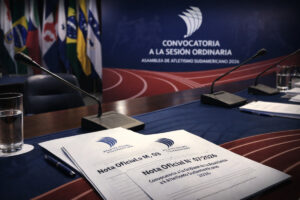
Coach licensing in South American athletics sits at the center of an institutional message signed by Ramiro Varela M (CEPALAC) and addressed to Sebastian Coe (World Athletics). In the letter—dated in Cali on February 22, 2026—the author requests that the issue be added to the agenda of the next World Athletics Council meeting.
Varela’s text draws a direct comparison with football’s coach accreditation pathway. As he explains it, the officially recognized licensing model promoted by CONMEBOL (FIFA) through university agreements works as a reference point for what he believes could be an equivalent structure in athletics, especially in South America.
Coach licensing in South American athletics and the Buenos Aires 2018 reference
The letter recalls that “seven years ago”, during the commemoration of the IAAF’s 100th anniversary in Buenos Aires 2018 and in Sebastian Coe’s presence, a similar scheme for athletics was requested and put to a vote—based on working with universities in each country.
According to the text, the former CONSUDATLE (now Atletismo Sudamericano and ADC Atletismo Sudamericano) voted against that proposal. The author then summarizes the lack of progress afterwards with a brief quote: “we signed an agreement, and nothing”, describing a process that did not move forward.
Within that context, the letter mentions “structural barriers”, particularly “in the relationship between Mr. GESTA and the ADC”. The author frames these as political issues with direct impact on development, without expanding further in the same document.
The request to the World Athletics Council
The core ask is that Coach licensing in South American athletics be formally included and discussed at the next World Athletics Council meeting. The letter calls it a “strategic decision” and a “continental urgency”, which—according to the author—extends to many countries in Central America and the Caribbean.
Varela argues the gap is widening: while football advances in academic certification and professionalization, South American athletics “remains behind”. In that framing, he stresses that talent exists, universities are willing, and coaches need a formal system for education and accreditation.
In practical terms, the request is positioned as an institutional step: moving the issue from informal exchanges into the sport’s decision-making forum at World Athletics.
Coach licensing in South American athletics and the Colombian university example cited
As a concrete reference, the letter states that CONMEBOL (FIFA) signed an agreement with the Universidad del Deporte de Cali to license coaches with official recognition, with support from the Colombian Football Federation. The author describes it as a “coordinated and effective” model and points to an official publication from the city of Cali regarding the agreement.
The same text also says that in Colombia there are currently five universities with authorization to provide training that leads to CONMEBOL/FIFA licenses:
- Universidad de Antioquia – Medellín
- Universidad San Buenaventura – Cali
- Universidad Sergio Arboleda – Bogotá
- Fundación Universitaria CEIPA – Barranquilla
- Escuela Nacional del Deporte
In contrast, the letter claims that athletics in South America does not have an equivalent Coach licensing in South American athletics system, which—according to the author—deepens the gap in professionalization and certification processes.
Institutional support: FEDACHI letter #025
On February 25, 2026, the Chilean Athletics Federation (FEDACHI) reported sending official letter #025 in support of CEPALAC’s request. In an email signed by Kurt A. Contreras S., FEDACHI’s General Manager, the message states: “I have the pleasure of attaching letter #025 expressing our support in response to the letter shared by Mr. Ramiro Varela (CEPALAC), which is attached.”
The email was addressed to south-america@aa.worldathletics.org and to Helio GESTA DE MELO (helio.gesta-de-melo@cm.worldathletics.org), copying cursos_desarrollo@atletismosudamericano.com, presidente@fedachi.cl, and other recipients listed in the same message.
In that context, FEDACHI’s communication is presented as formal backing for the request that Coach licensing in South American athletics be discussed at World Athletics Council level.
What the letter puts on the table
Beyond repeating the request to place the issue before the Council, the text emphasizes that Coach licensing in South American athletics is not framed as a purely administrative topic. For the author, it is a forward-looking decision summarized in a line: “The development of South American athletics requires leadership and action.”
In its closing section, CEPALAC describes itself as “the only sports think tank in Latin America”, created in connection with the Paris 2024 Olympic Games by leaders from Chile, Uruguay, Ecuador, Honduras, and Colombia. It also states it was notarized at the consulate in Paris (France) and is legally domiciled in Cali.
The exchange, as presented in the letter, opens a new chapter around Coach licensing in South American athletics and the possibility of building—through universities—a formal training and accreditation pathway for athletics coaches in the region, as requested in the correspondence sent to World Athletics.
More information on the Cali agreement referenced: official publication. The letter also mentions visiting Atletismo Sudamericano and its courses and development section.
Are you a coach or involved in coach education? Share your comment
This discussion on Coach licensing in South American athletics directly affects coaching practice and how the sport develops. If you are a coach, educator, athlete, federation official, student, or part of a club, your perspective can add real value from the region.
- Does your country have a formal licensing or certification pathway for athletics coaches?
- Would a university-based model with official recognition be realistic for athletics?
- What should a license prioritize (methodology, ethics, injury prevention, etc.)?
- What barriers have you seen when trying to professionalize coach education?
Leave a comment including your role (coach, athlete, official, student) and your country.










3 comentarios